
From Simple Rumble to True Haptics: The Evolution of Vibration Feedback in Game Controllers
What started as a crude "on/off" rumble has evolved into a subtle language of touch — modern haptic systems can simulate texture, weight, and even individual raindrops. Tracing this evolution shows how hardware, software, and design philosophy transformed controller feedback from a gimmick into a core part of the play experience.
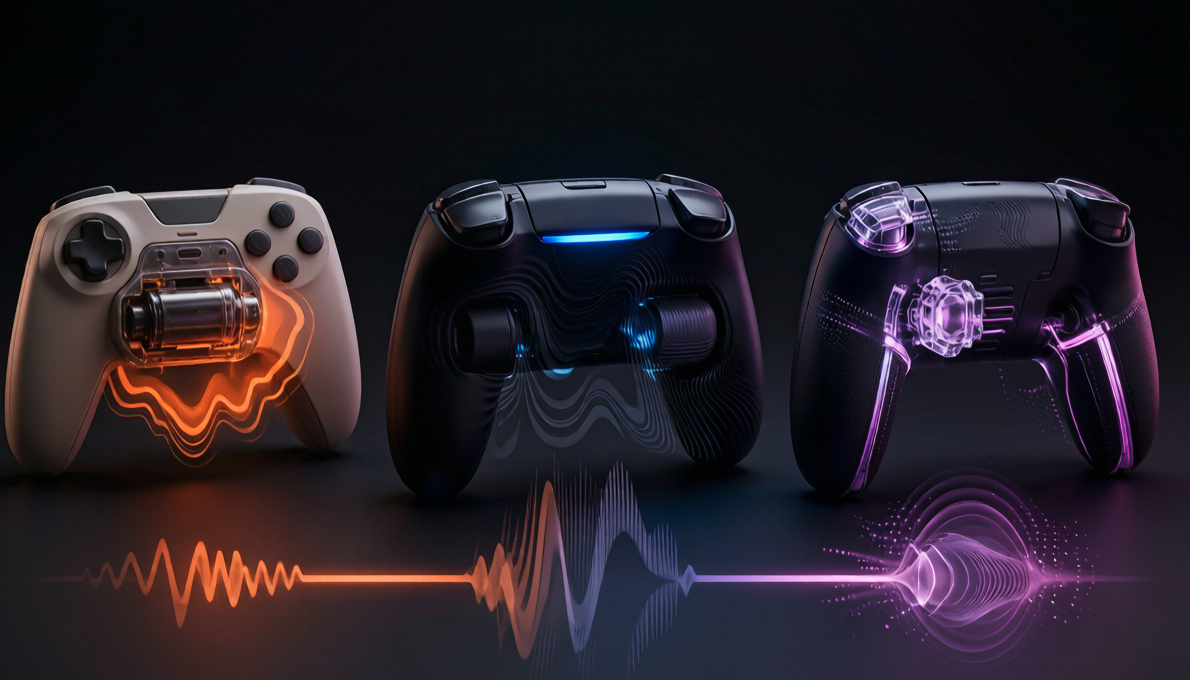
The Early Days: Simple Motors, Big Reactions
The first wave of vibration feedback in home consoles was built around a very basic idea: shock equals excitement. A small electric motor with an off‑balance weight was placed inside the controller. When the game sent a signal, the motor spun up, shaking the pad. The intensity and duration were usually fixed or had only a few levels.
Developers used this tool in obvious ways. Explosions, heavy impacts, and collisions triggered strong vibrations. Boss attacks caused long, dramatic rumble effects. Racing games shook the controller when the car hit a barrier or landed after a jump.
There was not much nuance in these early systems. The feeling was closer to a loud sound effect than a detailed message. Still, it changed something important: for the first time, the player's hands were not just sending input to the game — they were receiving physical output from it. This shift set the stage for more ambitious ideas. Once players got used to the controller moving, the next question was how to make those movements mean something specific, not just signal "something big happened."
Dual Motors and Directional Cues
The next major improvement came with the introduction of multiple motors inside a single controller, often one in each grip. Each motor could spin at a different speed or strength, allowing more complex patterns.
At this stage, the technology was still built around rotating weights, but the control over them had improved. The main innovation was not new hardware so much as better use of timing and balance. Game designers began thinking of rumble as a channel of information, not only as a spectacle. Even so, there were clear limits — the motors took time to spin up and slow down, which made very tight, quick patterns hard to achieve. The feeling was still mostly "buzzing" and "thumping," without fine texture.
- Direction hints — If the left motor activated more strongly, players could sense impacts or engine vibrations "coming from" that side. In racing, scraping a wall on the left could trigger a stronger left‑hand rumble, while the right stayed softer.
- Layered effects — A heavy, low‑frequency rumble could run continuously to simulate the roar of an engine or the movement of a giant creature, while a short high‑frequency burst indicated gunfire or sudden damage on top.
- Event variety — Instead of the same vibration for every explosion, designers could vary duration, intensity, and side. A grenade nearby felt different from a far‑off blast, and a sword clash did not feel like a collapsing building.
Refinement: Integrating Vibration into Game Feel
As controllers became standard across console generations, vibration feedback stopped being a rare extra and turned into a baseline expectation. Players simply assumed that action games, racing titles, and shooters would use rumble. This pushed developers to integrate feedback more deeply into game feel.
Under the hood, developers were working with what was still fundamentally an analog motor system, but the software control improved. Instead of just turning rumble on and off, they were sending precise patterns: short pulses, ramps, fades, and alternating sequences between left and right. The goal was less to surprise the player and more to reinforce what they were already seeing and hearing, tightening the connection between controller and on‑screen action.
- Weapon identity — Different guns or attacks got distinct vibration profiles. A heavy shotgun might deliver a sharp, powerful kick, while a light pistol only gave a short, gentle pulse. Melee impacts, reloads, and even empty‑clip clicks could each have their own pattern.
- Surface and movement — Driving over gravel, ice, or grass could trigger different rumble textures. Sprinting, sliding, or climbing ladders might all be given subtle feedback to reinforce the animation.
- Rhythm and timing — In rhythm games or carefully choreographed action scenes, vibration could underline the beat or accent key moments, matching the soundtrack and visual cuts.
The Shift Toward Haptics: From "Rumble" to "Feel"
The real transformation began when manufacturers moved beyond simple rotating motors and started using technologies that could produce high‑resolution haptics — linear actuators or advanced vibration modules capable of very fast, controlled movement. This shift allowed controllers to change intensity and frequency almost instantly, produce very short, crisp effects that older motors could not handle, and simulate different types of contact, not just generic shaking.
Instead of thinking in terms of "strong rumble vs weak rumble," designers could work like sound engineers, shaping vibration waveforms the way audio specialists shape sound. A rough scrape, a light tap, a soft thud, or a long, rolling tremor all became possible. The concept of haptics started to replace the looser term "rumble" — haptics implies an intentional attempt to reproduce meaningful tactile sensations, not just to add noise. The controller transformed into a sort of silent speaker, using the language of touch instead of sound.
These changes made the controller feel more alive even outside of combat or driving moments.
- The feeling of a bowstring tightening before release
- Individual footsteps having tiny, distinct pulses on different surfaces
- UI actions like menu selections giving a clean, sharp click under the thumb
Adaptive Triggers and Localized Feedback
The next major step was the combination of precise haptic modules with adaptive triggers and localized feedback zones. Modern controllers now offer triggers that can change resistance dynamically, separate haptic units positioned to give more local feedback, and fine‑grained control over which part of the controller vibrates — and how.
With adaptive triggers, game designers can simulate a gun trigger that becomes heavier as it reaches the firing point, make drawing a bow feel tight and tense as you pull back, and convey the difference between squeezing a car's accelerator gently and flooring it. Players no longer just feel that "something happened" — they feel how hard they are pushing, where the resistance lies, and when a mechanism catches or releases. This adds a mechanical layer to digital actions.
Localized haptics go further by letting different parts of the controller tell different stories: raindrops might feel like tiny taps moving across the surface, a passing train could create a wave of vibration from one side to the other, and the clack of a reloaded magazine might be focused mainly under the right hand. In practice, the controller begins to function as a small, handheld stage on which physical illusions are performed. The goal is no longer just to amplify big moments but to fill quiet moments with tactile richness.
Design Philosophy: Haptics as a Language, Not Decoration
As the technology matured, the design philosophy around vibration changed as well. The question shifted from "How can we make this moment louder?" to "What should this feel like?" Modern best practices treat haptics as a tool for clarity — helping players read game states like low health, weapon overheating, grip slipping, or car traction changing. It is also a tool for immersion, matching what the eyes see and the ears hear with what the hands feel, so the brain accepts the whole scene as one event. And crucially, it is a tool for restraint — avoiding constant buzzing that numbs the player's senses. The most memorable effects often come from contrast: moments of stillness followed by a sharp, meaningful pulse.
Developers must balance realism with comfort. A perfectly "real" recoil pattern or constant engine vibration might be tiring or even unpleasant during long sessions. So they tune effects to be expressive but not overwhelming, often exaggerating certain details while leaving others out entirely. Players now expect vibration settings to be adjustable or even fully disabled, both for comfort and accessibility. This pushes designers to ensure that haptics enhance the experience without becoming the only way to understand key information.
Looking Ahead: Beyond Vibration
The evolution from simple rumble motors to high‑resolution haptics suggests a direction for the future: richer physical sensations tied closely to on‑screen actions. Possible next steps include even more precise actuators that can simulate roughness, slipperiness, or impact at a fingertip level, controllers that can adapt their feel based on individual player preferences or play styles, and wider integration of haptics across platforms so similar sensations can exist on consoles, handhelds, and cloud gaming devices.
What is clear already is that vibration feedback has moved far beyond being a gimmick. It is now a carefully crafted part of game design, used to support storytelling, reinforce mechanics, and make virtual worlds feel less distant. From the first crude jolts to today's subtle haptic language, controller feedback has grown into one of the quiet strengths of modern gaming — felt more than seen, but impossible to ignore once it is gone.
Explore on Olgjoy Games
Ready to play? Browse free HTML5 games or read more guides.
More to read
Magic Consumption Mechanics in Games: Mana, Stamina, and Sacrifice Systems Compared
Magic consumption mechanics define how spellcasters pay for their power. From Mana pools to Backlash risks and Magic Slot preparation, each approach shapes tactical decision-making and player psychology in distinct ways.
Historical Accuracy vs. Gameplay: The Art of Compromise in Historical Games
Historical games carry the weight of representing real people, events, and cultures — yet they must also be fun. How developers navigate the tension between authenticity and playability, and why "believable" matters more than "accurate."
Balancing the Brutality of War and Entertainment: Narrative Ethics in WWII Games
WWII games face a unique ethical challenge: how to be engaging and fun while doing justice to the deadliest conflict in human history. The most successful titles refuse to glorify war — and prove that ethical engagement and compelling gameplay can coexist.
How Horror Games Are Using Sound Tricks and Visual Lies to Mess With Your Head
The most terrifying games today don't just make you jump — they make you question everything you hear and see. Audio puns and environmental misdirection are becoming the foundation of modern fear.