
The evolution of building styles in games: from the practicality of pixel blocks to the pursuit of purely decorative aesthetics
From crude pixel blocks to sprawling photo-realistic cities, the evolution of video game architecture tells a story about technology, ambition, and how we connect with virtual worlds.
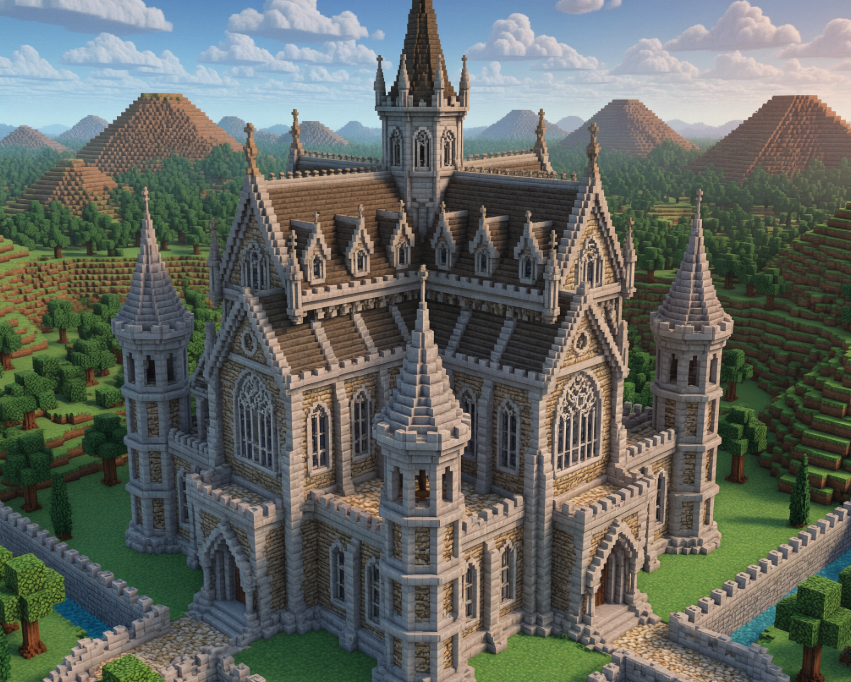
The Age of Pixels: Good Enough for the Hardware
If you've been playing video games for a few decades, you've watched one of the most remarkable visual transformations in any creative medium. What started as crude, colourful blocks on a screen has turned into sprawling, photo-realistic cities that can fool the untrained eye. The architecture in games has gone from simple, functional shapes to complex, atmospheric experiences that feel almost like art.
This shift tells a fascinating story about technology, ambition, and how we connect with virtual worlds.
Think about the hardware of the early 1980s. Processing power was so limited that many machines could only display a fraction of a full screen's worth of graphics at a time. This wasn't a design choice — it was a brutal necessity. Developers had to be masters of economy. Their goal wasn't to build a beautiful world, but a playable one with the fewest possible resources.
This limitation defined the architecture of the time. In the NES era, the resolution was a paltry 256×224 pixels, with only 64 colours available. You couldn't render a realistic house. So developers used icons. A simple rectangle with a triangle on top was instantly recognisable as a building. A pattern of brown and green blocks could suggest a wall or a forest. Players filled in the gaps with their imagination.
The architecture wasn't meant to be beautiful in the way we think of it today. It was functional — a canvas for gameplay. The level design in Super Mario Bros. or The Legend of Zelda used simple geometric forms to create clear paths, obstacles, and goals. The limitation of the medium made the design of space the primary focus. While the intricate, multi-layered worlds of later Mario games are now beloved, the architecture in the original 1985 game was simply a vehicle for platforming action.
As hardware improved, the visual language became more ornate. The 16-bit era brought larger sprites, more colours, and multiple scrolling background layers, creating a primitive sense of depth. Architecture could now be more than boxes. It could feature complex silhouettes, like the towering castles of Castlevania or the cyberpunk cityscapes of Streets of Rage. But the primary function remained the same: defining a playable space.
The Shift to Realism: Aspiring to Be "The Real Thing"
The introduction of 3D polygons in the 1990s was the true turning point. Developers were no longer just making a space to play in — they were trying to create a world. Suddenly, the goal was to build environments that looked and felt real.
This ambition pushed the focus from "function" to "experience." A prime example is the Assassin's Creed series. For Assassin's Creed Syndicate, set in Victorian London, the creative director said their biggest investment was in the city itself. The goal was to build a living, breathing city. That meant more than just putting up buildings. The team went to London to research the period, even building software that could generate thousands of historically accurate building facades. The architecture wasn't just a backdrop for running and climbing. It was a massive, historically-informed stage designed to create immersion.
This marked the beginning of the modern era of architectural design in games. Powerful GPUs and game engines allowed for detail that was previously unimaginable. This changed not just the visuals, but the workflow. In the past, a programmer wrote code to draw a pixelated house. Now, a team of specialists — concept artists, 3D modellers, texture artists, and lighting specialists — works together to create a single virtual building. Architecture was no longer a byproduct of code. It was a fully-fledged artistic discipline.
The New Frontier: Experiential Architecture
Today, the evolution has come full circle. While some games have achieved near-photorealism, the focus has moved beyond just looking good. We're now in an era of experiential architecture, where the design of a building or city is as much about the feeling it evokes as its appearance.
Theory from real-world architecture is now applied to game design. Concepts like figure-ground — creating contrast between solid building blocks and empty playable space — and form-void — how solid shapes define negative space — are used to build more intuitive and engaging levels.
Designers think about player experience in a more architectural way. They use techniques like "arrival," where a space is designed for a dramatic reveal, similar to how the ancient Athenians designed the path to the Parthenon. A modern example is The Legend of Zelda: Breath of the Wild, where emerging from the dark Shrine of Resurrection into the vast, sun-drenched world of Hyrule is a masterclass in using architectural contrast to create awe.
This shift is visible in the design philosophy of modern Assassin's Creed games, where the goal is to build not just a city, but a living, breathing entity. Developers use architectural principles to create a sense of place and history, turning the environment into a character in its own right.
The Enduring Legacy: From Functional Backdrop to Emotional Canvas
The evolution of video game architecture reflects the medium's own coming-of-age. In the beginning, architecture was a simple, functional necessity, defined by hardware limits. It existed to enable gameplay. As technology grew, so did the ambition to create spaces that were immersive, realistic, and historically detailed.
Today, the field has become a blend of art, technology, and psychology. Architectural design is no longer an afterthought but a core pillar of the experience, carefully crafted to evoke specific emotions and guide the player's journey.
From the limited colour palette of the NES to the ray-traced reflections of a modern virtual city, one thing has remained constant: the best video game architecture isn't just a world you see — it's a world you experience.
Explore on Olgjoy Games
Ready to play? Browse free HTML5 games or read more guides.
More to read

How Horror Games Are Using Sound Tricks and Visual Lies to Mess With Your Head
The most terrifying games today don't just make you jump — they make you question everything you hear and see. Audio puns and environmental misdirection are becoming the foundation of modern fear.
Retro Turn-Based Tactics: Innovation and Compromise in Modern Design
Developers keep going back to the 1990s for inspiration, but they're not just copying — they're adapting. Here's what works, what doesn't, and what the next decade holds for the genre.

Interactive Dynamic Music Systems: How Game Scores Adapt to Your Every Move
From vertical layering to horizontal resequencing, adaptive game music has quietly become one of the most sophisticated systems in modern game design. Here's how it works.

The Systematic Use of Color Psychology in Game Atmosphere Design: Warm vs. Cool
Color is the silent architect of a game's emotional landscape. From the angry reds of battle to the isolating blues of dread, here's how developers use color psychology to shape your experience.