
Differences in the best cornering lines for different drivetrains (FR/MR/4WD) in racing games
The perfect racing line isn't a fixed shape. It changes depending on where the power goes and where the weight sits. Here's how to adapt your technique for FR, MR, and 4WD cars.
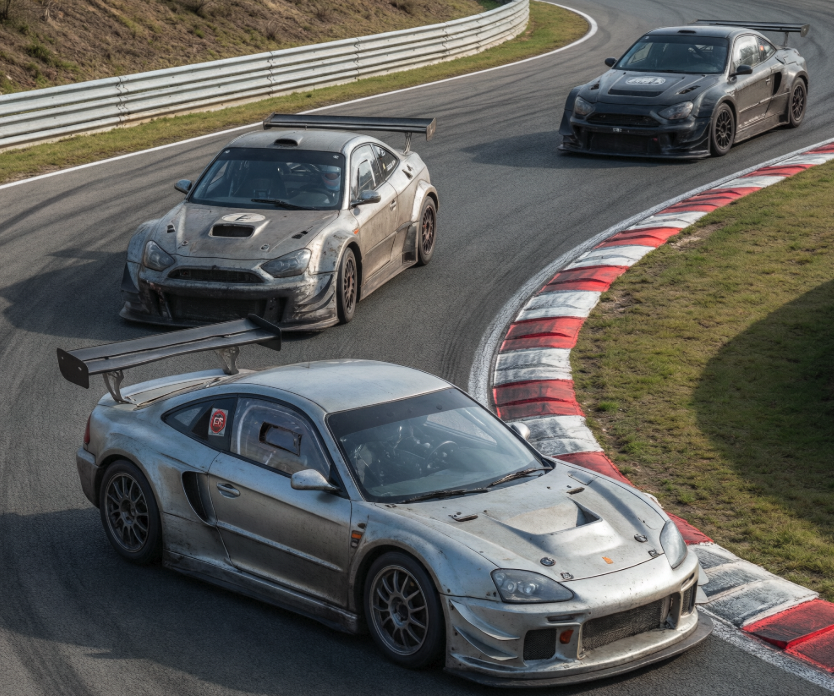
The Basics That Apply to Everyone
You've heard it a hundred times. "Slow in, fast out." "Hit the apex." "Use the whole track." These basics are universal. But if you've ever taken a front-wheel-drive hatchback and a rear-wheel-drive sports car through the same corner, you know there's more to it. The perfect line isn't a fixed shape drawn on the track. It changes depending on where the power goes and where the weight sits.
Understanding these differences is what separates fighting your car from dancing with it. Here's how to adapt your approach for FR (front-engine, rear-wheel drive), MR (mid-engine, rear-wheel drive), and 4WD (four-wheel drive) cars.
Before we get into the details, let's cover the constants. In performance driving, the goal is always the same: carry as much speed as possible through the corner while setting up for a strong exit. This usually means following an "out-in-out" line — starting on the outside, touching the inside apex, and tracking back to the outside on exit. This line makes the corner less sharp and lets you carry more speed.
Weight transfer is the key to making any of this work. When you brake, weight moves forward, loading the front tyres and giving them more grip for turning. When you accelerate, weight shifts to the rear, giving you traction for the exit. The art of driving fast is managing this weight transfer with smooth inputs on the wheel, brakes, and throttle.
With that foundation, let's look at how each drivetrain layout uses these rules differently.
Front-Engine, Rear-Wheel Drive (FR) — The Balanced Baseline
This is the classic sports car layout. Think Toyota GR Supra, BMW M3, or Mazda MX-5 Miata. Engine up front, power to the rear. These cars have a neutral balance that's often the most predictable for learning.
The Character: FR cars tend to oversteer — the rear end slides out — when you apply power aggressively mid-corner. The front wheels only steer, while the rear wheels handle acceleration. Mash the throttle, and you can overwhelm the rear tyres' grip, causing them to lose traction and the car to rotate more than you want.
The Line and Technique: The standard racing line works well for FR cars, but you can use their oversteer tendency to your advantage. You can actually use the throttle to help the car rotate. Brake slightly later than you would in a front-wheel-drive car, and trail-brake into the turn — continuing to brake as you start turning — to get the nose pointed toward the apex. Once you hit the apex, apply power smoothly. As weight shifts to the rear, it plants the drive wheels, and the mild oversteer helps unwind the car and point it straight down the exit.
Mid-Engine, Rear-Wheel Drive (MR) — The Precision Tool
With the engine sitting between the driver and the rear axle, MR cars like the Porsche 718 Cayman, Lotus Elise, and many modern supercars offer agility that's hard to match.
The Character: The central mass makes these cars incredibly responsive to steering inputs. They change direction with less effort than front-heavy cars. But this also makes them unforgiving. The rear-heavy balance can cause snap oversteer — where the rear end suddenly and violently swings out if you lift off the throttle mid-corner. The mass acts like a pendulum, and once it starts swinging, it's hard to stop.
The Line and Technique: Because MR cars can carry so much speed through the middle of a turn, your turn-in point will be slightly later than in an FR car, and you'll aim for a slightly later apex. This "square" line lets you straighten the wheel sooner, so you can smoothly apply the power coming out of the corner. The key to stability in an MR car is a constant, gentle throttle through the corner. You need a little throttle to keep weight shifted to the rear and stabilise the car. Sudden changes in throttle or steering upset the balance and invite the pendulum to swing.
Four-Wheel Drive (4WD/AWD) — The Grip Monster
All-wheel-drive cars like the Nissan GT-R, Subaru WRX STI, and many modern hot hatches use the traction of all four wheels.
The Character: With power going to all four wheels, 4WD cars have incredible traction, especially on corner exit. This makes them forgiving for amateur drivers — they're less likely to spin the wheels. The main downside is a tendency toward understeer — the front end pushing wide — on entry and mid-corner, because the front wheels are asked to both turn and put down power.
The Line and Technique: To overcome understeer, the optimal line shifts. You'll often need to turn in a little earlier, "dive-bombing" the apex to get the nose pointed in the right direction. Because the front wheels are reluctant to turn, you can sometimes use heavy trail-braking to keep weight on the front tyres, helping them bite into the corner. The exit is where the 4WD car shines. It builds up understeer through the corner, but you can use a massive amount of throttle to power through the exit understeer. Some drivers use a hint of oversteer to rotate the car, but most rely on the front tyres to pull through.
V-Shape vs. U-Shape: Adapting to the Track
The racetrack itself dictates which technique works best. There are two basic philosophies for taking a corner.
The V-Shape: This is a late-braking, aggressive style where you dive for the apex, turn sharply, and sacrifice mid-corner speed for a powerful exit. It's ideal for tight corners leading onto long straights, and it suits cars that need rear rotation, like MR and FR cars.
The U-Shape: This is a smoother, more rounded style where you carry maximum speed through the middle of the turn. You brake earlier and more softly to keep the car stable and trace a more "arcing" line. It's preferred for high-speed, flowing corners.
A professional driver adapts to each corner, switching between V and U based on what comes next, and that decision is heavily influenced by the car's drivetrain. A powerful 4WD car might use a V-shape to get an early jump out of a corner, while a high-grip MR car might use a U-shape to carry speed where others can't.
The Bottom Line
The racing line isn't a single path. It's a concept that adapts to the machinery. The FR car asks you to dance on the throttle. The MR car demands laser-like precision and stability. The 4WD machine rewards aggression with raw grip. Learning to shift your line just a foot or two, and adjust your pedal timing, is what separates a driver from a racer.
Explore on Olgjoy Games
Ready to play? Browse free HTML5 games or read more guides.
More to read

Co-op Game Recommendations for Couples: Five 'Relationship Boosting' Picks Perfect for Non-Gamer Partners
The best co-op games for non-gamer partners are welcoming, forgiving, and fun to fail at together. Here are five picks that focus on teamwork, not twitch reflexes.

How Horror Games Are Using Sound Tricks and Visual Lies to Mess With Your Head
The most terrifying games today don't just make you jump — they make you question everything you hear and see. Audio puns and environmental misdirection are becoming the foundation of modern fear.

20 Indie Games to Watch at Gamescom 2026
From KRAFTON's second-party showcase to the hidden gems of Hall 10.2, here are the indie titles that deserve your attention at Gamescom 2026.

Retro Turn-Based Tactics: Innovation and Compromise in Modern Design
Developers keep going back to the 1990s for inspiration, but they're not just copying — they're adapting. Here's what works, what doesn't, and what the next decade holds for the genre.